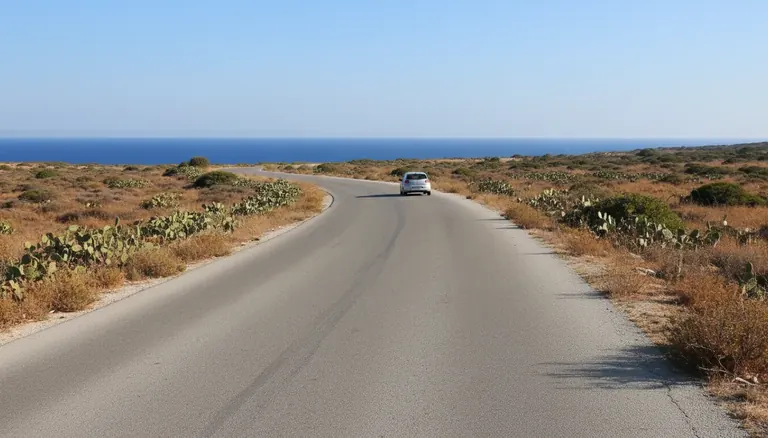
Driving in Cyprus: Road Rules for Pissouri
Cyprus drives on the left, uses km/h, and has no toll roads — a straightforward switch for British drivers. A UK photocard licence is all you need; no International Driving Permit required.
Compare Car Hire DealsSearch & Compare Car Hire Deals
Free cancellation on most vehicles
Driving on the Left: The UK-Friendly Basics
Cyprus is one of the easiest Mediterranean destinations for British drivers. As a former British colony, it kept the same left-hand traffic system, so overtaking, roundabouts and lane discipline all feel familiar from day one. Road signs are bilingual (Greek and English) and distances are in kilometres. Before you set off, arrange collecting your car at the airport so you leave the terminal already oriented to local roads.
- Drive on the LEFT — same as the UK
- Give way to traffic from the RIGHT at roundabouts
- Distances and speed limits in km/h
- English on almost all road signs
- UK photocard driving licence valid — no International Driving Permit needed
- Currency is the Euro (EUR)
- No toll roads anywhere on the island
- Hire cars carry distinctive red number plates
Red plates make it immediately clear to other drivers and police that you are in a hire vehicle, which generally means a degree of tolerance for hesitation at junctions — though not for moving violations.
Speed Limits & the Camera Network
Speed limits in Cyprus are clear and consistent. The A6 motorway that runs along the south coast near Pissouri has a maximum of 100 km/h and a minimum of 65 km/h. Rural roads outside built-up areas are limited to 80 km/h, and towns drop to 50 km/h. Enforcement is increasingly automated: Cyprus has deployed hundreds of fixed and average-speed cameras, which have issued hundreds of thousands of fines.
How camera tolerances work
Motorway cameras are reported to trigger at roughly 121 km/h (a 20% tolerance above the 100 km/h limit), while urban cameras tend to activate around 58 km/h. Do not treat tolerances as a target — enforcement criteria can change without notice.
| Offence | Fine | Points |
|---|---|---|
| Crossing the stop line at red | €25 | 0 |
| Stopping on the pedestrian crossing at red | €85 | 3 |
| Entering the junction against red | €300 | 3 |
| No seatbelt | €150 | 3–6 |
| Using a mobile phone while driving | €150 | 3 |
Camera fines are mailed to the registered owner of the vehicle — the hire company — not to you directly. The company then deducts the fine from your payment card and adds its own admin fee, typically €40–€50, often weeks after you have returned home. Check your card statement carefully after any trip.
Drink-Drive Limits
Cyprus enforces a blood-alcohol limit of 0.5 g/l (approximately 22 micrograms per 100 ml of breath). That is meaningfully stricter than the 0.8 g/l limit that applies in England and Wales, meaning one drink fewer before you reach the legal boundary. For drivers with fewer than three years of experience, and for all commercial drivers, the limit falls to a near-zero 0.2 g/l.
| Driver category | Limit (g/l blood) | Approx. breath (µg/100 ml) |
|---|---|---|
| Standard Cyprus driver | 0.5 | 22 |
| Novice / under 3 years' experience (Cyprus) | 0.2 | 9 |
| Standard driver — England & Wales | 0.8 | 35 |
A designated sober driver is essential if your itinerary takes in the Troodos wine villages or the local Commandaria wine estates along the foothills. Penalties include licence suspension, heavy fines and possible imprisonment — the hire company will also void your CDW cover if an accident occurs while you are over the limit.
Child Seats, Seatbelts & Equipment
Cyprus child-restraint law is height-based rather than age-based. Every child under 150 cm must travel in an appropriate restraint; the specific requirement depends on the child's height. Seatbelts are compulsory for all occupants front and rear, and non-compliance carries a €150 fine with penalty points added to the driver's licence.
- Under 135 cm — full child seat mandatory
- 135–150 cm — booster seat mandatory
- Under 150 cm in any case — no child may travel unrestrained
- Rear-facing seat in the front — only permitted if the passenger airbag is disabled
- Non-compliance fine: €150–€300 plus penalty points
Pre-book child seats directly with your hire firm when reserving the car. Availability at the counter on the day is not guaranteed, particularly during summer school holidays. Confirm the seat type (infant, convertible, booster) against your child's height before travelling.
A warning triangle and a hi-vis vest are strongly recommended in Cyprus. While the specific mandatory requirements for hire cars are managed by the operator, carrying both items adds no weight and could be essential if you break down on a fast rural road.
Petrol & Refuelling Around Pissouri
Petrol and diesel grades work exactly as in the UK. Unleaded 95 (equivalent to E10) and 98 (equivalent to super unleaded) are widely available across Cyprus, and diesel pumps are at every main station. Pissouri itself has limited fuel infrastructure — the nearest reliable option is the Petrolina station on Leoforos Pafou in the Pissouri area, which operates 24 hours and switches to automated card-only payment outside staffed hours. A wider choice of stations sits east towards Episkopi and west towards Kouklia.
- Fill up before entering Pissouri — do not rely on finding a station once in the village
- Automated pumps place a temporary pre-authorisation hold of around €60 on a UK debit or credit card
- The hold is released within a few days once the actual transaction settles
- LPG is uncommon — if your hire car requires it, confirm availability before leaving the depot
- Keep a rough eye on the gauge when heading into the Troodos hills — stations thin out above 700 m
- Petrolina and EKO accept major UK cards; carry a small amount of cash as a back-up at rural automated pumps
Fuel prices in Cyprus are broadly comparable to the UK, occasionally a few cents cheaper per litre. Prices are displayed on forecourt boards and updated regularly — there is no price-fixing, so brief comparisons between stations in larger towns can save a few euros on a longer trip.
Insurance & Excess Explained
Every hire car in Cyprus comes with basic Collision Damage Waiver (CDW) included in the rate, but that cover contains significant gaps. The excess — the amount pre-authorised on your card and charged if the car is damaged — typically runs from €800 to €1,500. Beyond the excess, standard CDW excludes tyres, glass, the undercarriage and any damage that occurs on unsealed tracks.
Before you explore the dirt-track beaches around Pissouri, be clear that every insurance option — desk upgrade or standalone UK policy — voids cover the moment you leave sealed tarmac. Stick to surfaced roads.
| Cover | Typical cost | Excess | Notes |
|---|---|---|---|
| Basic CDW | In base rate | €800–€1,500 | Excludes tyres, glass, undercarriage, off-road |
| Desk Super CDW | €15–€25 per day | Zero on bodywork | Still excludes off-road driving |
| UK standalone excess policy | £3–£6 per day | Reimbursed | Buy before you fly; off-road excluded |
UK standalone excess policies (providers such as iCarHireInsurance and Questor) reimburse you after you have paid the hire company, rather than reducing the hold on your card upfront. You will still need a credit card with sufficient headroom to cover the full excess pre-authorisation at the desk. Keep all receipts and the damage report if you need to claim.
Once you have sorted your cover, compare car hire deals to find the best base rate before adding any extras at the counter.
Frequently Asked Questions
Do I need an International Driving Permit for Cyprus?
What side of the road does Cyprus drive on?
Are there toll roads in Cyprus?
How do speed-camera fines work for hire cars?
What is the drink-drive limit in Cyprus?
Is my hire car insured on dirt tracks?
Ready to compare car hire deals in Pissouri?
Check live prices and availability from local and international suppliers.
Compare car hire deals